A Comprehensive Legal and Operational Guide for Aspiring Entrepreneurs
Starting a new business venture is an exhilarating journey, yet it requires navigating a foundational landscape of legal structures, regulatory compliance, and strategic planning. For millions of solo entrepreneurs around the globe, the sole proprietorship stands out as the most accessible, intuitive, and straightforward vehicle to bring a business idea to life. Characterized by its lack of bureaucratic red tape and operational agility, this structure allows an individual to exercise total control over their commercial destiny. However, transitioning from a conceptual blueprint to a legally recognized entity requires a precise understanding of what this framework entails and how to effectively execute a Proprietorship Firm Registration.
Understanding the Sole Proprietorship Structure
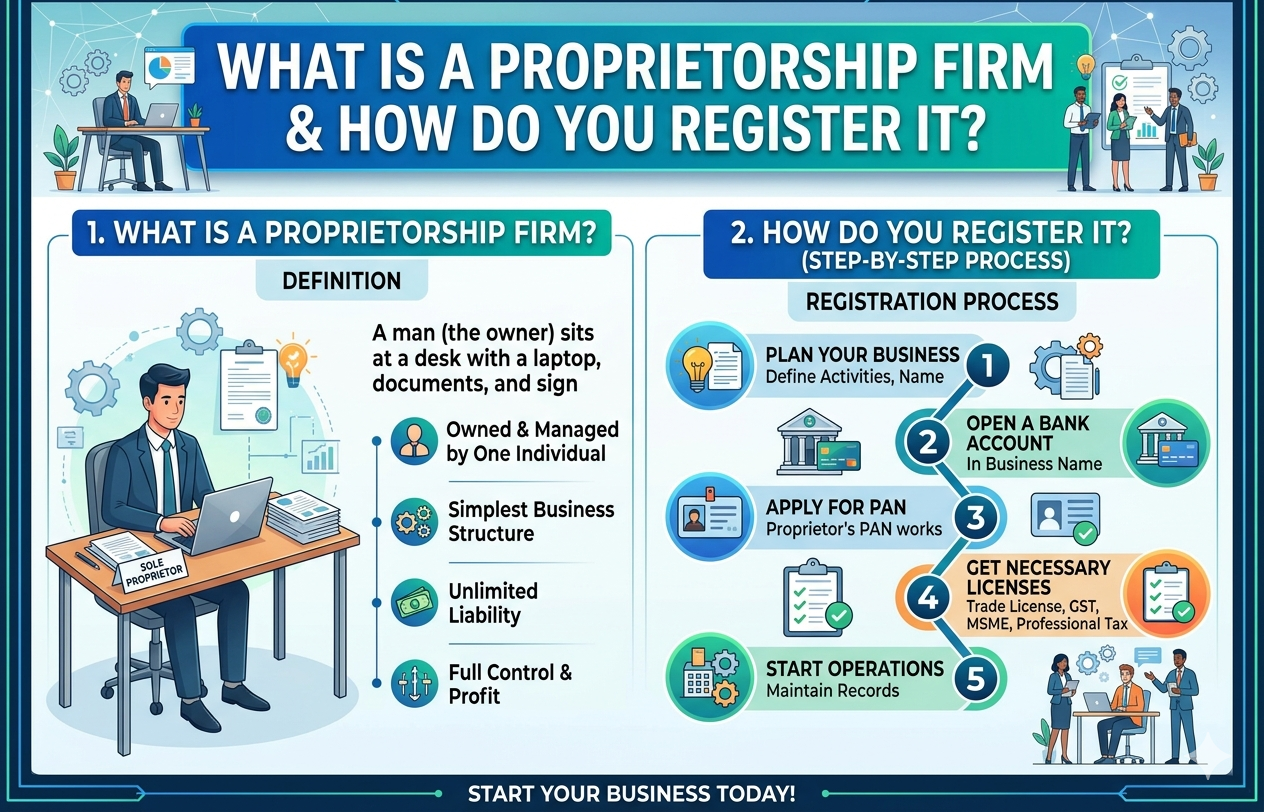
A sole proprietorship—frequently referred to as a proprietor firm—is a business model where a single individual owns, manages, directs, and assumes total responsibility for the commercial entity. From a legal standpoint, the business does not possess a separate identity from its owner. The proprietor and the firm are considered a single entity under the law. This lack of legal separation has profound implications: all profits flow directly to the owner’s personal income, but conversely, all liabilities, financial obligations, and legal debts attach to the owner’s personal assets.
Because there is no distinct corporate veil, the establishment of such a firm does not inherently require a complex incorporation process like a Private Limited Company or a Limited Liability Partnership (LLP). Instead, the entity is recognized through the individual licenses, tax enrollments, and local statutory registrations it secures to operate commercially within its specific jurisdiction.
The Core Advantages of a Proprietor Firm
Before initiating the formal process of Proprietor Firm Registration, entrepreneurs must weigh the unique benefits that make this structure highly popular among micro, small, and medium enterprises (MSMEs):
- Ease of Formation and Lower Cost: Unlike corporate entities that demand extensive registration fees, compliance modeling, and drafting of constitutional documents like Articles of Association, a sole proprietorship can be established rapidly with minimal financial expenditure.
- Absolute Control and Decision-Making: The owner enjoys absolute hegemony over all operations. There is no requirement to convene board meetings, seek shareholder consensus, or navigate internal corporate politics. Decisions can be made instantly to seize market opportunities.
- Simplified Tax Compliance: Since the business is legally indistinguishable from the owner, the firm itself does not file a separate corporate income tax return. Instead, the business’s revenue and expenditures are declared directly on the individual proprietor’s personal tax returns, simplifying the accounting lifecycle.
- Operational Confidentiality: Public and private limited companies are mandated by law to publish financial statements and operational audits periodically. A proprietorship, however, preserves the financial privacy of the owner, keeping business margins and accounts safe from public scrutiny.
Strategic Note: While the advantages are compelling, every entrepreneur must remember that unlimited liability means personal assets—such as real estate, savings, and personal property—can be liquidated by creditors to settle outstanding business debts or legal judgments.
Step-by-Step Procedure for Proprietorship Firm Registration
Because a sole proprietorship is not governed by a dedicated federal statute in many jurisdictions, there is no single, unified “Certificate of Incorporation” issued for it. Instead, Proprietorship Firm Registration is achieved by obtaining a cocktail of mandatory and optional tax, labor, and local government registrations. This multi-layered registration officially validates the firm’s commercial existence and enables it to interface with banking systems and corporate clients.
Step 1: Choosing a Unique Business Name
The first step is selecting a trade name under which the business will operate. While the business can legally trade under the owner’s legal name, creating a distinct brand name often helps establish market authority. The name must not infringe upon existing trademarks or match registered corporate entities within the same industry sector.
Step 2: Obtaining a Permanent Account Number (PAN) and Identity Credentials
In a proprietorship structure, the owner’s personal PAN card acts as the financial identifier for the business. All tax filings and legal compliance steps are linked to this number. Along with the PAN card, valid identity proofs (such as a passport, driver’s license, or national ID) and address proofs for both the individual and the business location (such as utility bills, lease agreements, or property deeds) are foundational for all subsequent registrations.
Step 3: Registering under Local Labor and Shops Laws
To establish a physical place of business, storefront, or office, entrepreneurs must register under their local municipal or state-level Shop and Establishment Act. This license regulates working hours, employee terms, and local commercial zoning compliance. It serves as prime legal proof of a functioning commercial entity and is heavily relied upon by financial institutions during corporate onboarding.
Step 4: Goods and Services Tax (GST) Enrolment
Securing a GST or local sales tax registration is a cornerstone of formalizing your Proprietorship Firm Registration. In most regions, registration becomes legally mandatory once the firm’s annual turnover crosses a specific threshold. However, choosing voluntary registration early on is highly advantageous. It allows the firm to collect taxes, claim input tax credits on business purchases, and build trust with formal B2B clients who require tax-compliant invoicing.
Step 5: Micro, Small, and Medium Enterprise (MSME) Registration
Registering the firm through government MSME portals provides substantial strategic advantages. This government enrollment yields a formal certificate verifying the business’s existence. It unlocks structural benefits, including priority sector bank lending, lower interest rates on commercial loans, subsidies on intellectual property filing, and legally mandated protections against delayed payments from corporate buyers.
Step 6: Opening a Dedicated Business Current Account
To maintain financial clarity and operational transparency, a proprietor must separate business transactions from personal funds. To open a commercial Current Account, banking institutions typically mandate at least two official government registrations (such as a GST certificate, MSME registration, or a Shop & Establishment license) along with the owner’s identity documentation. The current account enables seamless vendor payments, merchant integrations, and smooth audit trails.
Long-term Compliance and Regulatory Maintenance
Completing your Proprietor Firm Registration is merely the initiation phase; maintaining its active legal status requires continuous compliance. Proprietors must file periodic sales tax and GST returns according to local deadlines, even if the business records zero revenue during a particular period. Annual individual income tax filings must accurately incorporate all business profits and losses. Additionally, any changes to the business operating address, structural updates, or municipal licenses must be promptly updated with relevant authorities to avoid financial penalties or structural suspension.
Conclusion: Is a Proprietorship Right for You?
A sole proprietorship offers an unrivaled mix of autonomy, swift execution, and low compliance friction, making it the ideal choice for freelancers, local consultants, independent creators, and early-stage startup founders testing product-market fit. By systematically navigating the steps of Proprietorship Firm Registration, you establish a solid legal baseline that transforms a solo vision into a verified commercial enterprise. As the business scales, generates consistent revenue streams, and takes on greater operational complexities, this foundation can seamlessly evolve into a more structured corporate entity, paving the way for long-term growth and market success.